
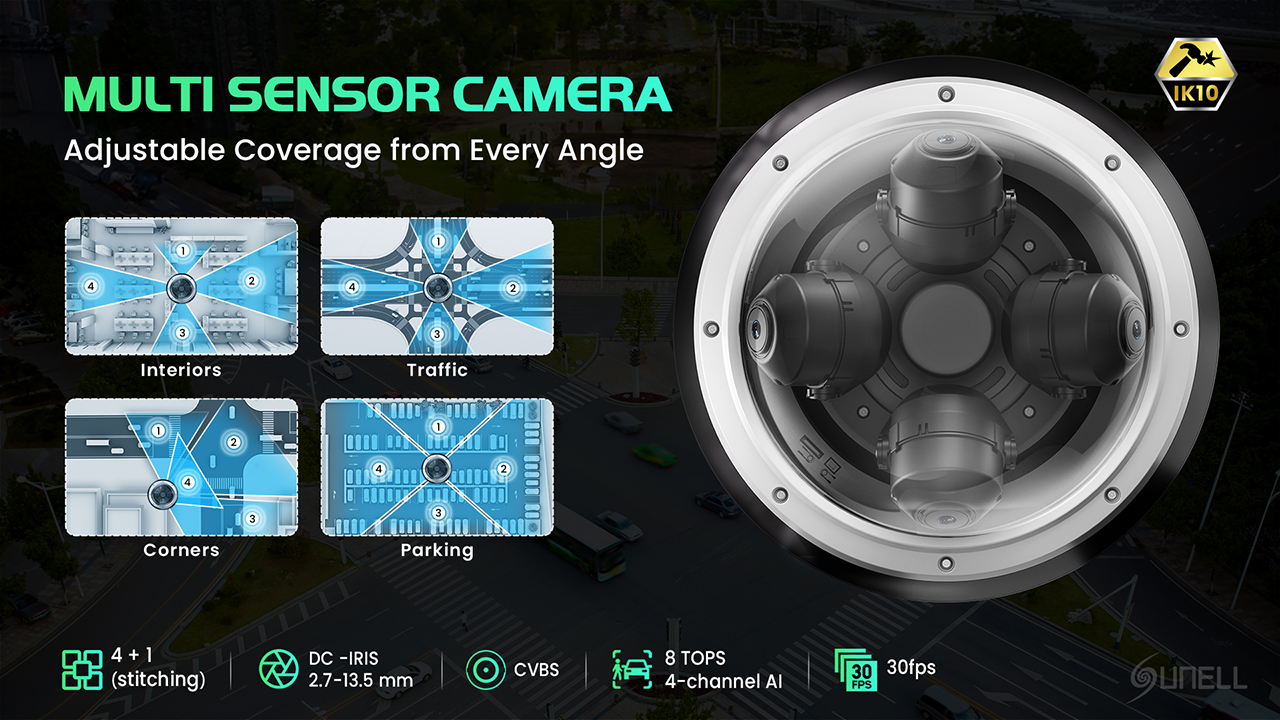
Quando si sceglie la telecamera di sicurezza giusta per le proprie esigenze di sorveglianza, ci si trova di fronte a una varietà di opzioni. Tra le più popolari ci sono le telecamere di sicurezza multisensore, a sensore singolo e fisheye. Ogni tipo offre vantaggi distinti ed è adatto a diversi ambienti e requisiti di sicurezza. In questo articolo, confronteremo questi tre tipi di fotocamere per aiutarti a prendere una decisione informata.
Comprendere le basi
Telecamere di sicurezza a sensore singolo
Le telecamere a sensore singolo sono il tipo più comune di telecamere di sicurezza. Utilizzano un sensore di immagine per acquisire riprese video. Queste telecamere sono disponibili in varie forme, tra cui modelli bullet, dome e PTZ (pan-tilt-zoom), e sono ampiamente utilizzate sia in ambienti residenziali che commerciali.
Telecamere di sicurezza multisensore
Le telecamere multisensore sono dotate di più sensori di immagine, che in genere vanno da due a quattro sensori all'interno di un singolo alloggiamento. Ogni sensore cattura una parte della scena e il software della fotocamera unisce queste immagini per creare un campo visivo ampio e senza interruzioni. Le telecamere multisensore sono particolarmente apprezzate in aree di grandi dimensioni in cui è necessaria un'ampia copertura.
Telecamere di sicurezza Fisheye
Le fotocamere fisheye utilizzano un singolo sensore abbinato a un obiettivo ultra grandangolare che cattura una visione a 360 gradi. La curvatura dell'obiettivo produce un'immagine panoramica o emisferica, consentendo alla telecamera di coprire un'intera stanza o un'area aperta senza punti ciechi. Le telecamere fisheye sono spesso utilizzate in negozi al dettaglio, uffici e altri spazi interni.
Principali differenze e vantaggi
1. Campo visivo e copertura
Telecamere a sensore singolo: Typically provide a narrower field of view, usually between 70 to 120 degrees. While this is sufficient for many applications, covering large areas may require multiple single sensor cameras, which can increase costs and complexity.
Telecamere multisensore: Offer a much wider field of view, often up to 180 degrees or more, depending on the number of sensors. These cameras are ideal for monitoring expansive areas like parking lots, stadiums, and large warehouses, reducing the need for multiple cameras.
Fotocamere fisheye: Provide a 360-degree view from a single point, covering an entire room or area. This makes them highly effective in indoor environments where complete coverage is essential without needing to install multiple cameras.
2. Qualità e risoluzione dell'immagine
Telecamere a sensore singolo: Usually offer high-resolution video, often in 4K, depending on the model. The clarity and detail are typically excellent, but the coverage is limited to the field of view of the lens.
Telecamere multisensore: These cameras can also offer high-resolution images, but because the resolution is spread across a wider area, the clarity may be slightly lower when zooming in on distant objects. However, they still provide excellent detail and overall coverage.
Fotocamere fisheye: While fisheye cameras capture a broad view, the image can be distorted due to the curvature of the lens. Many modern fisheye cameras have de-warping software that corrects this distortion, but the resolution might not be as high as that of a single sensor camera focusing on a specific area.
3. Installazione e posizionamento
Telecamere a sensore singolo: These are easy to install and can be placed in a variety of locations. However, achieving full coverage of a large area may require multiple cameras, which can increase installation time and costs.
Telecamere multisensore: Offer more coverage with fewer devices, simplifying installation in large spaces. These cameras are often mounted in corners or along walls to maximize their wide field of view.
Fotocamere fisheye: Typically installed on ceilings in the center of a room to provide complete 360-degree coverage. This placement makes them ideal for indoor spaces where a single camera needs to monitor an entire area.
4. Considerazioni sui costi
Telecamere a sensore singolo: Generally the most affordable option, especially for small-scale installations. However, costs can add up when multiple cameras are needed for larger areas.
Telecamere multisensore: Typically more expensive upfront than single sensor cameras, but they can be more cost-effective in the long run by reducing the number of cameras and installation points needed for wide-area coverage.
Fotocamere fisheye: Price varies depending on the model and features, but they offer cost savings by reducing the number of cameras required for full coverage in a given area. However, their image quality in large spaces might not be as sharp as other types.
5. Casi d'uso
Telecamere a sensore singolo: Best suited for focused monitoring areas such as entryways, hallways, or areas where high detail is required in a specific direction.
Telecamere multisensore: Ideal for large, open areas where wide coverage is necessary without the use of multiple cameras, such as parking lots, large retail stores, or industrial sites.
Fotocamere fisheye: Perfect for indoor areas where 360-degree coverage is desired, such as in offices, retail spaces, and warehouses, allowing full visibility with a single camera.
Conclusione: quale fotocamera è giusta per te?
La scelta della telecamera di sicurezza giusta dipende dalle tue esigenze specifiche:
Se hai bisogno di una copertura dettagliata e focalizzata in una direzione specifica, una telecamera a sensore singolo potrebbe essere l'opzione migliore.
Per grandi aree che richiedono un'ampia copertura con punti di installazione minimi, le telecamere multisensore offrono una soluzione efficiente ed efficace.
Se si desidera una copertura completa di una stanza o di un'area aperta con un unico dispositivo, una telecamera fisheye fornisce una vista panoramica con punti ciechi minimi.
Ogni tipo di telecamera ha i suoi punti di forza e la scelta migliore dipende dall'ambiente che stai monitorando e dal tuo budget. Comprendendo le differenze tra telecamere a sensore singolo, multisensore e fisheye, puoi selezionare l'opzione migliore per migliorare il tuo sistema di sicurezza.
Sei pronto a migliorare la tua configurazione di sorveglianza? Esplora la nostra gamma di telecamere di sicurezza e trova la soluzione perfetta per le tue esigenze.